In many History and English classes at Tech, teachers construct their lessons around current events.
“I taught…Persepolis which is [about] what was happening in Iran, so we looked at…current events there and compared it to the book,” said Mrs. Tatyana Green, a 10th and 12th grade English teacher.
Discussions on American politics, local elections and foreign affairs are fairly commonplace in English and Social Studies classes. Teaching the Israel-Palestine conflict, though, is unlike most other issues because of the charged political environment surrounding the topic. Tech teachers who address the subject in class can draw complaints of bias, and even antisemitism, and are strongly encouraged to run their lessons by administrators. In the Social Studies department, teachers were told that having administrators screen their lessons for curricular alignment provides a basis for support from the school should tensions arise.
Social Studies teacher Mr. Adam Stevens said that the suggestion to screen lessons on the Israel-Palestine conflict “is an implicit restriction” that makes it so that “the simplest way to deal with [the restriction] is to not teach the topic.”
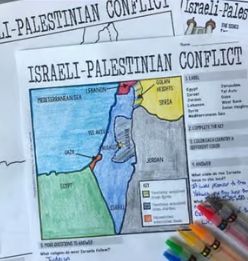
This is not to say that the Israel-Palestine conflict goes untaught. It is required content in 10th grade AP World and Regents Global History courses, and before the October 7, 2023 Hamas attacks on Israeli civilians, and the resulting war, many teachers taught lessons and led open discussions on Israel and Palestine. Those lessons have now come under scrutiny after some teachers, students and parents raised concerns.
According to AP World History and Sociology teacher Mr. Joshua Silverman, since October 7, teachers “have been given far more top-down guidance and far more warnings than I have ever received in my [20 years] in the classroom.”
Social Studies teachers who wish to teach lessons on the conflict have been told to be mindful in their approach. This includes being highly sensitive to the nuances of the issue, addressing multiple perspectives and rigidly adhering to the curriculum.
Silverman explained that these precautions are unusual.
“[We] have never previously been told that we must get our lessons pre-approved,” he said. “We have never previously faced that level of scrutiny about how we teach an issue, even a contentious issue, like the Armenian genocide, or capitalism and socialism.”
Even conversations between teachers have been difficult to undertake. When Stevens wanted to hold open department discussions in the wake of October 7, Dr. Judith Jeremie, the Assistant Principal of Social Studies, said that the appropriate place for teachers to discuss Israel-Palestine was “in Fort Greene Park.”
“We were not to discuss it in the Social Studies department office,” Stevens said. “We were not to discuss current events or history.”
Jeremie explained that “using the school for any political activities or discussions” by teachers while at work is prohibited by the school chancellor’s regulations, although nothing in those regulations explicitly makes this point.
As Assistant Principal of Social Studies, Jeremie evaluates Israel-Palestine lesson plans for teachers in her department.
“Everything always has to be grounded in the framework or the curriculum,” she said. “If it’s an AP class it has to be [in the Course and Exam Description]. If it’s a Regents class, it has to be New York State framework.”
Jeremie added that the issue is all the more complicated because it is unfolding in real time.
“[It’s] happening right now, [so] everyone is really trying to absorb it,” she noted. “We don’t have all the details so I tell [teachers] to ground it in the facts that we know and also the information that we have to teach.”
Most teachers whom The Survey reached out to were hesitant or unwilling to talk about teaching the Israel-Palestine conflict.
“There have been a lot of [teachers across the country] who have been pretty formally sanctioned…for comments that they’ve made [about the Israel-Palestine conflict],” explained Silverman. He added that teachers in the Social Studies department at Tech have “been told that this is the kind of issue where your job and your employment is on the line.”
“I’m taking a risk talking to you right now,” said Stevens, when asked about his comfort level teaching and discussing the conflict.
Sanctions and restrictions on teachers nationwide may explain why teachers at Tech are tight-lipped about the conflict. Controversy and censorship in schools have grown since the re-election of Trump, whose administration has pushed to punish speech it dislikes, going so far as to attempt to deport non-U.S. citizen academics because of their pro-Palestine activism.
This academic crackdown has spread across the country, and expanded beyond just the Israel-Palestine conflict. Even in a Democratic bastion like California, the state recently passed a law restricting what teachers can say in classrooms.
The targeting of speech has had an impact in classrooms across the country. According to a recent Morning Consult poll of K-12 teachers, 52 percent “report having had to modify their curriculum or class discussions topics because of political pressure.” Additionally, 56 percent of teachers say they have independently chosen to limit discussions on political and social issues in class in the past year, a 13 percent increase since March.
For Israel-Palestine, the easiest and safest option for teachers is to avoid teaching about the current and even historical conflict, but many students are eager to learn about it.
Recent Biological Sciences major alum and Israel Culture Club executive, Sonia Kushnovski (‘25), said she knows that “people in the school talk about it, even though there [aren’t lessons].”
Kushnovski thinks that “to have a space to talk about it would be good instead of just acting like it doesn’t exist.”
Another recent alum, Social Science Research major Duaa Taweel (‘25) agreed there should be a space for discussion “because it’s not only extremely relevant, but [because] Palestinians are people just like any other people and deserved to be acknowledged, especially in a time of genocide.”
While the use of the term “genocide” in this context is hotly debated, an independent United Nations committee found that the actions of Israel in the Gaza strip amount to genocide, for the “killing, causing serious bodily or mental harm, deliberately inflicting conditions of life calculated to bring about the destruction of the Palestinians in whole or in part, and imposing measures intended to prevent births.”
Between the Middle East, Russia-Ukraine and China-Taiwan, Stevens noted that many students at Tech “come from parts of the world where warfare is either a current reality, a decades long reality or a looming reality.” He thinks that Tech would benefit from “a searching and explicit and intentional conversation on what it has meant for our students and their families to live in a period of accelerating, compounding war.”
Biological Sciences major Awaab Atique (‘26) thinks that “it would be really beneficial to learn about [the Israel-Palestine conflict],” so that students could base their opinions on the issue from unbiased sources. He added that learning about the conflict in school could bring students closer, and make them more comfortable talking about a topic that many consider taboo.
Social Science Research major Kay Brahm-Robin (‘26) said she sees “general student dissatisfaction with the education around the Israeli Palestine conflict.”
In her own experience of learning about the conflict, Brahm-Robin has observed contradicting lesson goals, “between wanting to represent this very pressing issue, but then also being very withdrawn about it, and it kind of results in a dumbing down of the conflict in a way that claims to represent, you know, the harsh realities of it, but actually doesn’t touch upon it at all.”
Brahm-Robin is helping to organize students to advocate for more lessons and education on Israel-Palestine in and out of classrooms.
“[It] doesn’t have to be crazy changes, but I think people need their voices to be heard, and I think a club is a good way of doing that.”
Brahm-Robin’s goals may find support among some teachers at Tech. Despite the controversial nature of the Israel-Palestine conflict, Stevens thinks that teachers have a responsibility to educate students on the issue, even as he questions whether he is doing enough to address the topic with his students: “I am probably too comfortable. I am probably not taking the risks that this moment in history requires of me.”