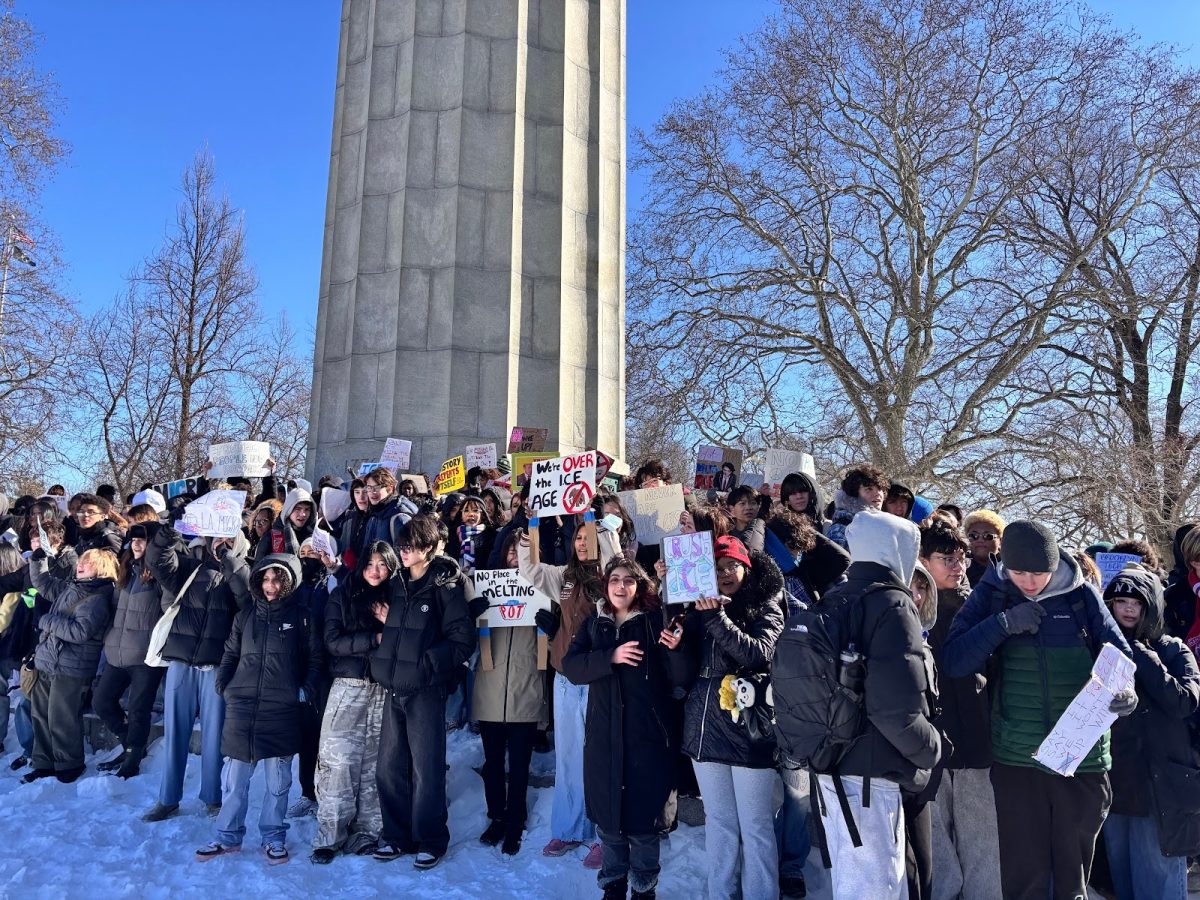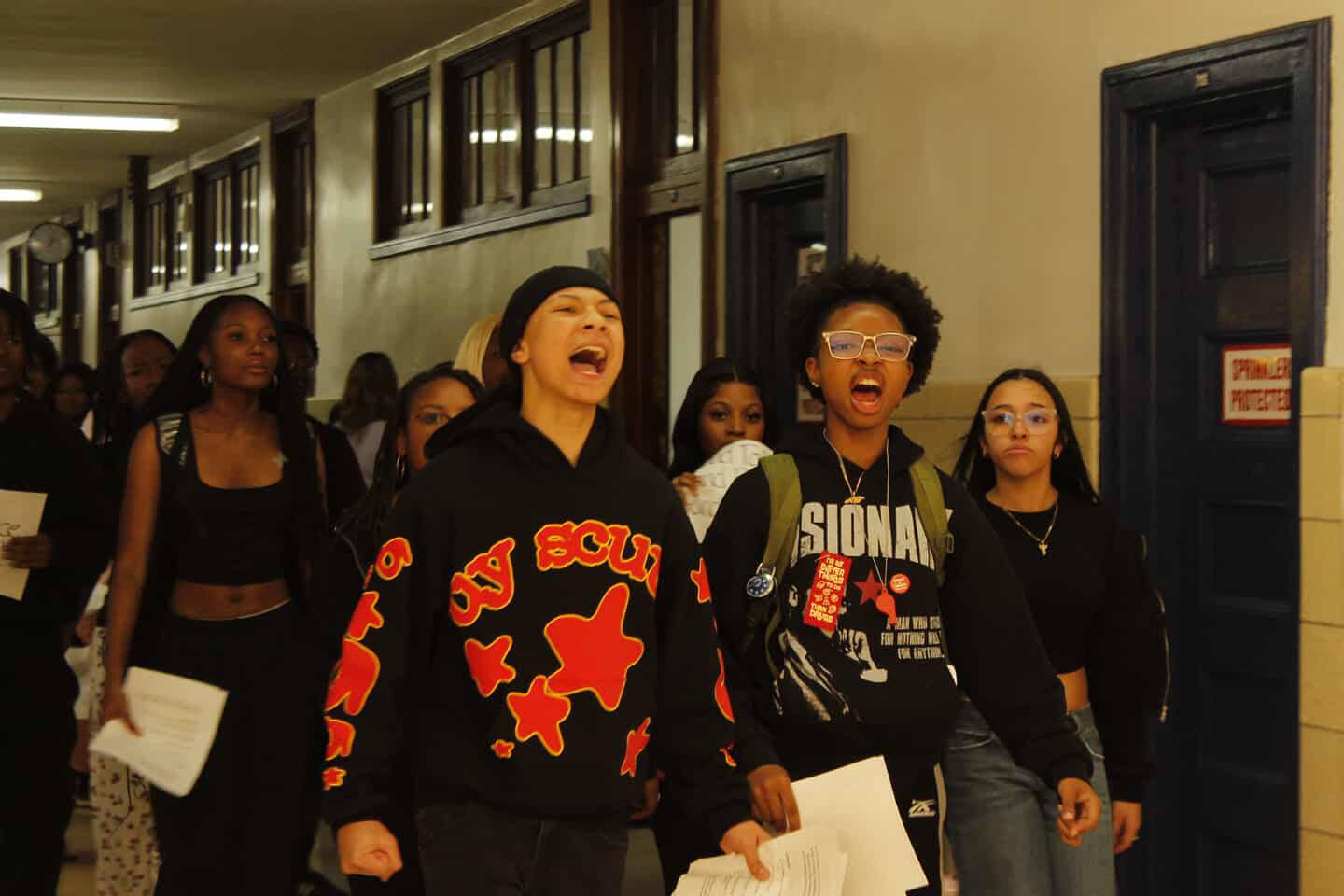
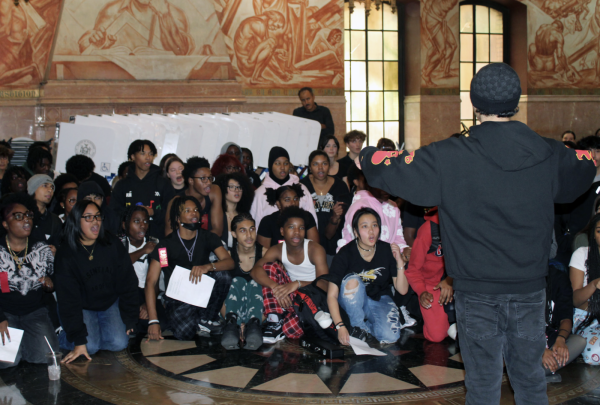
On Monday, October 27th, nearly 100 students engaged in a protest against racism at Brooklyn Tech in reaction to underrepresentation of Black students and an incident of hate speech. This turnout represented over a third of the Black student population, as just 5% of Tech’s nearly 6,000 students are Black. The protest was organized by Black at Tech, an emerging group headed by Leighanne Harris (Finance ‘27), co-president of Caribbean Culture & Service Club (CCS), and Justyn Rodriguez (Law and Society ‘27), a board member of the Black Student Union (BSU).
At the start of sixth period, students travelled from the cafeteria to the first floor, passing every classroom on the way. Chants like “I love my skin, I love my school” echoed down the hallways. Other calls included “Black Students Matter” and “Stand Tall Stand Black Stand Tech.”
Earlier in the day, Principal Newman said he “caught wind of” the forthcoming demonstration and called student organizers into a meeting with representatives from the Superintendent and Chancellor’s offices during third period. Despite reservations about disruption to classes, Newman allowed the protest to proceed.
Harris said the timing and form of the disruption was calculated. He explained the majority of participants were free during sixth period, and only major classes have testing on Monday, minimizing disturbance. Additionally, though student walkouts are common at Tech, the “walk-in” approach sought to create a “civil disruption” and to display that there is a strong and vibrant group of Black students, as Harris emphasized.
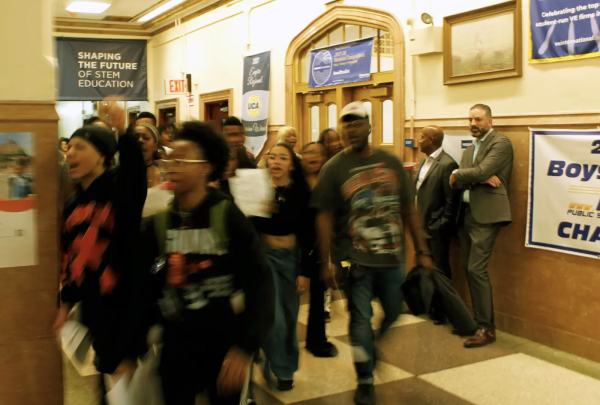
Assistant Principal of Guidance Jan-Kristòf Louis-Mansano, Assistant Principal of Health and Safety Lisa Iacono, BSU advisor Adam Stevens and other faculty accompanied as the group reached the entrance to the auditorium.
Student leaders had created a protest run sheet, that Mr. Stevens called “the most organized protest document [he’s] seen in 18 years at this school,” directing participants to “gather and chant in the [first floor] center while taking a knee.” The document was printed and distributed to protestors and included thorough notes about the conduct expected for participants, including refraining from phone use, profanity, or running around in the hallways.
Addressing the gathered crowd, Harris and Rodriguez spoke about the precedent of racial controversies at Tech and the school’s shrinking population of Black students.
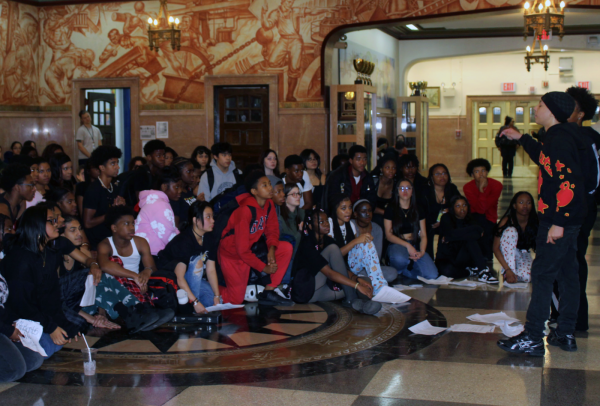
Harris and Rodriguez also read the preamble of a letter to the school administration that the two authored together.
“As proud Black Technites, we feel as though it is our responsibility to ensure the betterment of our conditions in this space,” the letter read. “Year after year, incident after incident, we are forced to turn the other cheek to the vitriolic and spirit-breaking racism that plagues our school. While we are consoled by the school administration with empty promises [there is] no outright protection against the abuse our community faces everyday.”
Rodriguez touched on the experiences behind this statement.
“[Before the protest] we were collecting testimonies from the members of our movement of their personal experiences with [racism],” he said. “We actually read [the testimonies] out at the meeting on Monday and it was a really powerful moment to hear the things that our freshmen already are going through in just October. And it went silent for a few seconds because it genuinely is spirit breaking.”
Origins of Protest
The immediate catalyst for the protest was an anonymous Instagram account exposing racist text messages sent by a Tech student. An unknown individual posted the texts as screenshots without the consent of the person who allegedly sent the texts. The student in question declined a request for comment.
The messages included numerous uses of the n-word, statements like “i really hate all black [people],” and further objectionable comments about gay and Jewish people. Most strikingly, a voice memo was released of the student naming a fellow student leadership classmate and referring to him and his community as the “Black n***** friend group.”
“The way it was received is that an injury to one is an injury to all,” said Mr. Stevens. “She was talking to one person in the Black community, but a lot of people in the Black community were like, ‘She’s talking to all of us.’”
Rodriguez explained that BSU has made a concerted effort in previous years to engage Black and Latino students at freshman orientation and to display to new students that may otherwise lack representation that there are “people who look like us and teachers who support us.” To hear the connections produced through these community-building efforts described as a “Black n***** friend group” struck a profound chord with the students who responded through the protest.
The Instagram account spread throughout the student body over the course of the preceding weekend, until it disappeared from the platform the day after the protest. Mr. Newman said he reported the account, but it is unclear whether direct intervention from Instagram or a decision by the account’s anonymous creator lead to the account’s removal. Questions also remain about who accessed the student-in-question’s phone and whether their a subsequent apology was AI generated, but the protest chose to focus on broader concerns about hostility toward Black students at Tech.
Mr. Newman addressed the school in an email the day of the protest, writing, “We are aware of the use of a racist hate-word amongst our community. Racism and hate speech have no place at Brooklyn Technical High School… There was a student protest today against hate speech in and around our community. Our school community took all steps and precautions to ensure that students and staff remained safe, and that there was minimal disruption to school operations.”
Student Responses
As part of the protest, students put up fliers and sticky notes with slogans like “Neutrality is Violence” and “We All Bleed Red.” One poster and protest chant was “Fix the system not the students,” alluding to a structural problem that supersedes condemning the actions of a single student.
Kelsey Kelman (‘29) spearheaded the messaging, creating 480 posters in the two days following the protest. Kelman said she aimed for “short and simple quotes that carry a strong political and moral question” and that the posters “became an important part of the #blackattech movement.” Mr. Newman said of the posters that he, “appreciated the lack of profanity and allowed them to stay up for the better part of the week [of the protest].”
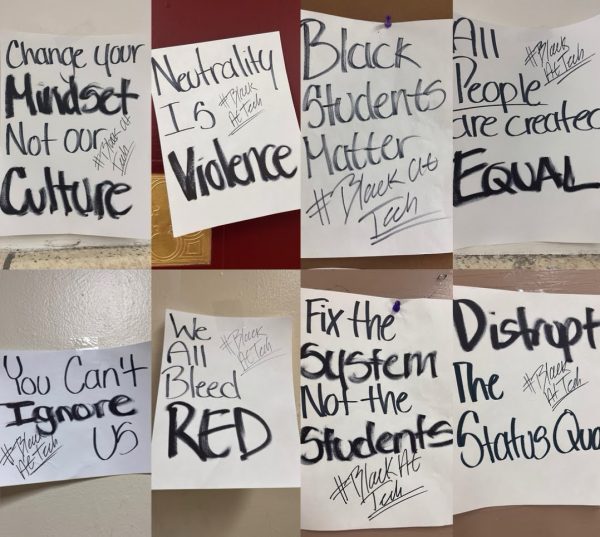
Some posters were torn down and stepped on. In one case, a sticky note that said #BlackatBtech and Black Students Matter was scribbled out and the n-word was written instead.
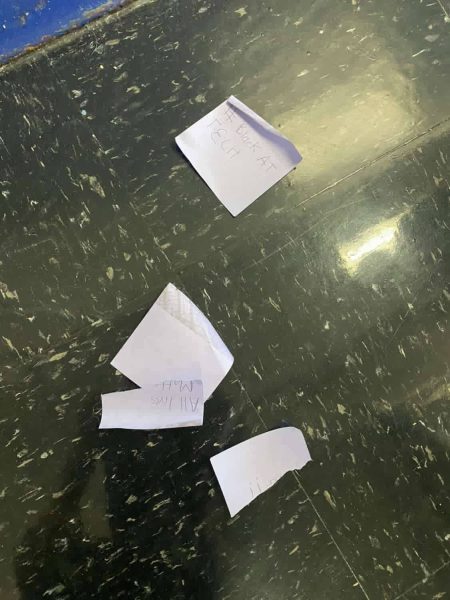
The use of this word is not isolated to the Instagram account or a single sticky note. In the fourth floor boys bathroom, the same racial slur was written in gum the day after the protest and was not removed for at least 24 hours.
As the students came to see the offending messages on Instagram, many reposted them, reviving #blackattech and contending that the language and views in the leaked racist statements were not uncommon at Tech.
Since the protest, led by Harris and Rodriguez, Black at Tech has emerged as an organization separate from BSU and other affinity clubs.
A History of Combatting Racism
The #blackattech hashtag originated on Facebook as #blackinbrooklyntech where it made national news in 2016 when students posted comments from guidance counselors and teachers like, “The day you get above a 90 average I’ll grow an Afro,” and “You’re so smart for a black person.”
Harris described reading some of these 2016 testimonies at the protest and contrasting them with more recent examples of racist speech directed at Black students.
“What’s changed?” he reflected. “2016 sounds pretty recent, but it’s been almost 10 years and Black kids only have it worse.”
In response to the 2016 incidents, the NYC Department of Education provided anti-discrimination training to faculty in 2016.
Mr. Newman revealed that freshman and senior advisory classes will now receive similar lessons on “-isms and -obias” and hate speech this fall.
“When you say something racist it’s out of ignorance, and education fights ignorance,” he said, clarifying that classes “might seem like a reaction [to the protest], [but] the lessons were already written and in place before this.”
Rodriguez added that Black at Tech is making its own efforts to educate the community.
“We’ve already had some of the students in our movement going into classrooms and spreading awareness so these are already starting within our first week,” he explained.
The SHSAT and Underrepresentation of Students of Color
Mr. Linder, AP African American Studies teacher, drew a connection between the single digit percentage of Black students in specialized high schools and students being comfortable using racial slurs and being discriminatory. “When the only representation of those marginalized peoples…[is] the viewing of them as outsiders because of their underrepresentation in our school, the foundation is laid for discriminatory and racist actions.”
“If they were surrounded by Black kids, they would never say [n*****],” added an anonymous Black student.
According to the New York City Council and the most recently released NYC report, despite Black and Hispanic students representing 66% of the NYC public school system, and nearly 45% of those who take the Standardized High School Admissions Test (SHSAT), they received just 9% of enrollment offers in the fall of 2024.
This fall, Black students received just 3% of the offers, compared to 4.5% last year, and Hispanic students experienced a similar drop. These numbers continue to shrink as White and Asian acceptances increase each year. Even with low Black enrollment at Tech, the school has almost double the average Black student population, by percentage, at specialized high schools.
Of the eight specialized high schools, five admitted ten or fewer Black students this fall. Stuyvesant, considered the most prestigious of these high schools, accepted just eight Black students into a freshman class of 781 this year.
The causes of this disparity include socioeconomic inequities, racially homogenous neighborhood middle schools, gaps in test preparation and tutoring, uneven school funding, and poor outreach to Black and Hispanic middle schools. Mr. Louis-Mansano and other Tech faculty have brought underrepresented middle schools for tours in an attempt to raise application numbers, but the trend remains stubborn.
“The administration has done nothing to side against the SHSAT admissions policy that has had the result of shutting the doors of what everyone sees as the finest schools in New York City to Black and Latino students,” expressed Mr. Stevens.
Mr. Newman, however, has no control over the enrollment at Tech, which is overseen by DOE staff that handle admission to all specialized high schools. The SHSAT itself is enshrined in state law and cannot be changed even by city government.
“It had Discovery programs, […] but in terms of impacting Black enrollment, which has gone down every year for the 18 years that I’ve been here. I stand by my statement that they have done nothing,” Mr. Stevens continued.
Mr. Newman agreed with the assessment that the Discovery program and other efforts have been ineffectual, saying, “There have been a lot of efforts over time to change the demographics of these schools to reflect demographics of the city, but so far it hasn’t worked. I have some ideas of how we can move the needle, and I believe every middle school student should take the exam without having to register, and I think we’re moving in the right direction.”
As Black enrollment continues to fall, Black students find themselves leaning on supportive teachers and separating themselves from the student body, for example by spending free periods in classrooms.
“I couldn’t imagine not having the safe space and the safe teachers and Black staff in the school because everything would descend into chaos,” Harris said. “The amount of racism that I see is already a little bit decreased because I’m so just entrenched in my own community all the time, but I should be able to walk around and relax in the cafeteria without hearing someone make racist remarks.”
The existence of a Black subculture at Tech was not always the norm. In the 1970s and 1980s, Black and Latino students made up the vast majority of Tech’s student body.
“When alumni come back from 20 or 30 years ago, and we tell them our experiences, they’re like, ‘What? When I was at Tech I had a great time,’” said Harris. “They were more integrated within their school life. It wasn’t like they had their separate Black part of Tech … where they hung out separate from the school – and I feel the divide between the races, and the divides specifically between the Black community and others.”
Going Forward
Students who do face racism and bullying at Tech also have challenges reporting it.
“If I heard something derogatory or racist I don’t know where I would necessarily go, whether a teacher or dean or parent,” said Tess Goldfarb (‘28). “I don’t think many people know…where do you go when you hear something like this?”
Harris also described a time burden that falls on students who want to report harassment. “If I’m in class and I hear someone make an off comment … I have to choose between whether I want to go to my next class, or maybe skip my test to go to the deans about an incident of racism,” he said. “And maybe it’s not even taken all that seriously, you know? So I feel like that’s a barrier itself and it should be easier to report.”
In the absence of effective channels for reporting harassment, people often take to social media to call out wrongdoing and demand punishment.
To address these ambiguities, on October 29, Mr. Newman announced a new anonymous reporting channel ([email protected]), through which students are urged to “contact Ms. Iacono at [email protected] and/or Ms. Liu at [email protected] to report any acts, in person or through on-line communications, of sexual harassment, intimidation, discrimination, bullying, and racism that you may have heard about or have witnessed.”
These ongoing efforts alongside the Black at Tech movement together seek unity and safety for all students. “Our main goal for our movement is to do a dramatic shift in the culture of racism at Tech, a complete systematic change,” concluded Rodriguez.